
The Crown
Rosemary the Crown
FOODSOULMINDHEALTH
Uncle Umar
7/2/20268 min read

The Crown
Rosemary: The Herb of Memory, Flavor, and Fragrance
This is another natural tool I've used on my road to recovery after my stroke. My testimony is that for the last 3 years I have used a Rosemary tincture daily to sharpen my cognitive ability. It is a staple of my cooking routine as well. All I can say is God is GOOD.
“The Crown” Rosemary has a long history of ritual, medicine, and symbolism, especially in ancient Egypt, Greece, and Rome. It was used in burial rites, worn or burned for memory and purification, and later became linked with fidelity, remembrance, and protection.
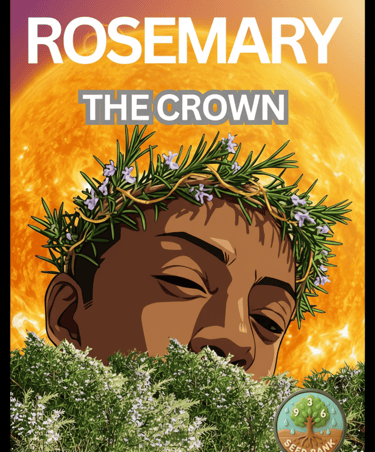
Its ancient names and associations included the Greek antos meaning “flower of excellence” and libanotis, referring to its incense-like scent. It was also later known as the “herb of remembrance” and, in some traditions, the “Crown” because students and scholars wore it in garlands.
Rosemary is one of those herbs that feels familiar even before you cook with it. You recognize it by its needle-like leaves, its piney scent, and, in warmer climates, its small blue, pink, purple, or white flowers [2]. It has a reputation that stretches far beyond the kitchen, because people have used rosemary for flavor, fragrance, remembrance, and traditional healing for centuries [2][1]. Today, rosemary remains one of the most useful herbs you can grow, buy, or keep in a spice jar.
What makes rosemary special is how much it offers in a single sprig. It can sharpen a roast chicken, brighten potatoes, freshen a room, and add a sense of ritual to daily life [2]. It also carries a long cultural history, from ancient Egypt and Greece to medieval Europe and modern wellness culture [2]. That mix of usefulness and symbolism is part of why rosemary has lasted so long in human life.
What Rosemary Is
Rosemary is an evergreen shrub from the Mediterranean region, and its name is often explained as meaning “dew of the sea” [2]. It belongs to the mint family, and it grows well in sunny, well-drained conditions [2]. In some climates it can live for decades, which helps explain why it is both a garden plant and a kitchen staple [2].
The herb’s flavor is bold. It is often described as piney, minty, medicinal, and tea-like, with a slightly bitter edge [2]. Because the flavor is strong, a little goes a long way. That is one reason rosemary is so effective: it does not fade into the background, but it also does not need to overwhelm a dish.
Rosemary in the Kitchen
Rosemary is most famous as a culinary herb, and for good reason. It pairs especially well with meats like lamb, pork, chicken, and fish, and it also works beautifully with potatoes, mushrooms, stews, breads, and roasted vegetables [2]. In many cuisines, it is used in herb blends, marinades, soups, and olive oil infusions [2]. Its sturdy leaves hold up well during cooking, which makes it especially practical compared with more delicate herbs.
One of the best things about rosemary is how it adds depth to simple food. A tray of potatoes becomes more fragrant with a few sprigs of rosemary and olive oil. Roast chicken tastes more complete with rosemary tucked under the skin or added to the pan. Even bread can be transformed when rosemary is kneaded into dough or sprinkled on top before baking [2].
Here are a few easy examples:
- Rosemary potatoes: toss potato chunks with olive oil, garlic, salt, pepper, and chopped rosemary before roasting.
- Rosemary chicken: add whole sprigs to the cavity or baking dish for a fragrant, savory finish.
- Rosemary olive oil: infuse olive oil with rosemary and use it as a dip for bread or a drizzle for vegetables [2].
Rosemary is also good in smaller touches. Finely chopped leaves can be added to focaccia, casseroles, pasta sauces, and vinaigrettes [2]. Because it keeps some flavor even when dried, it is a reliable pantry herb when fresh rosemary is not available [2]. For home cooks, that consistency is part of rosemary’s appeal.
A Herb With History
Rosemary has a long historical record. According to the McCormick Science Institute, there is evidence of rosemary being offered in ancient Egypt, and in ancient Greece it was associated with strengthening memory [2]. Students were said to wear rosemary garlands while studying or taking examinations [2]. That idea of rosemary as a herb of remembrance has stayed with it for centuries.
During medieval times, rosemary had both practical and symbolic uses. It was used in folk medicine, and in France it was even used to embalm the dead [2]. Across Europe and Australia, rosemary has been used in commemorations and funerals as a symbol of memory, love, and fidelity [2]. Shakespeare even gave it a memorable line in Hamlet: “There’s rosemary, that’s for remembrance” [2].
The herb’s historical meaning is part of its charm. People did not just cook with rosemary; they attached stories to it. That gives rosemary a cultural weight that many modern herbs do not carry. In a blog post, that history helps the herb feel alive rather than merely botanical.
Traditional Medicinal Use
Rosemary has a long folk-medicine history, and modern research continues to explore some of those traditional claims [1][2]. Historically, rosemary was used for issues such as mental decline, pain, dysmenorrhea, epilepsy, and infertility, though these older uses were based on tradition rather than modern clinical proof [2]. Today, rosemary is still discussed for possible effects on memory, stress, inflammation, and digestion [1][2].
Scientific reviews suggest that rosemary contains antioxidant and anti-inflammatory compounds, including rosmarinic acid and carnosic acid [1][3]. Rosemary also contains aromatic oils such as 1,8-cineole and alpha-pinene, which contribute to its scent and are being studied for their biological effects [1][4]. In a review of rosemary compounds, researchers noted its potential in areas like cognition, inflammation, and antioxidant protection [3]. Another source highlights that rosemary has been studied for possible benefits related to stress reduction and mental focus [5].
This does not mean rosemary should be treated as a cure-all. It means the herb is interesting because it sits at the crossroads of tradition and science. For general wellness writing, it is fair to say that rosemary has a long history of use and promising modern research, but stronger clinical proof is still needed for many claims [1][3].
Rosemary and the Mind
Rosemary is often linked to memory, alertness, and mental clarity. That idea goes back to ancient Greece, where rosemary was associated with strengthening memory [2]. Modern research continues to examine those claims, especially in relation to rosemary’s compounds and aroma [1][5]. While the evidence is not definitive, the herb’s reputation as a “focus” plant remains strong.
Many people like rosemary tea or rosemary aroma during study or work sessions. A rosemary scent can feel energizing and bright, which is part of why it appears in wellness products and diffusers [5]. Even without making medical claims, that sensory effect matters. A fragrance that helps people feel more awake or clear-headed has value in everyday routines.
This is one reason rosemary works well in content for adult audiences. It is practical, attractive, and easy to relate to. People understand the appeal of a herb that can sit on a stovetop, in a tea cup, or on a desk in diffuser form.
Rosemary’s Aroma
Rosemary’s scent is one of its strongest selling points. The herb is intensely aromatic, with a clean, piney, camphor-like note [2][6]. That fragrance comes from volatile oils stored in the leaves, and those oils are a big part of why rosemary is used in cooking, fragrance, and household products [3]. Even a small amount can change the feel of a room or recipe.
Because of that aroma, rosemary is used in more than food. It appears in fragrances, soaps, bath products, and essential oil blends [3]. It is also used in sachets and home remedies because the scent is associated with freshness and cleanliness [6]. For home and lifestyle content, rosemary is a natural fit because it bridges kitchen, wellness, and atmosphere.
If you want a simple aromatic example, try placing a fresh sprig in a bowl of warm water near the stove or adding rosemary to simmer pots with citrus peel. The result is fresh, herbal, and comforting. It gives a room a clean scent without feeling artificial.
What Modern Research Says
Modern research is especially interested in rosemary’s antioxidant and anti-inflammatory compounds [1][3]. These properties matter because oxidative stress and inflammation are involved in many health discussions, from aging to brain health [3]. Rosemary extracts have also been studied for preservation in food because of their natural antioxidant activity [3].
A detailed review of rosemary’s therapeutic potential notes that rosemary diterpenes such as carnosic acid and carnosol have been investigated for several biological activities, including antioxidant and anti-inflammatory effects [3]. The same review also notes possible relevance to cognitive health and neuroprotection, including research related to Alzheimer’s disease models [3]. This is promising, but it is still research, not a reason to replace medical care.
For a general audience, the best way to present this is straightforwardly: rosemary is more than a seasoning. It is a herb with a real scientific profile, even though many of its health claims still need more human studies [1][3]. That balance keeps your writing credible and accessible.
How to Use Rosemary Daily
One of rosemary’s strengths is how easy it is to incorporate into daily life. You do not need a special setup or complicated recipe. A few sprigs in the kitchen can already make a difference [2]. If you want a simple routine, think in three categories: food, scent, and simple tea.
Try these practical ideas:
- Cooking: add rosemary to roasted potatoes, chicken, pork, fish, or bread [2].
- Aroma: use rosemary in a diffuser, bath blend, or simmer pot for a fresh herbal scent [3].
- Tea: steep fresh or dried rosemary in hot water for a simple herbal drink [3].
Buying, Growing, and Storing
Rosemary is easy to grow in sunny, well-drained conditions, and it can be pruned and harvested multiple times [2]. Many people keep it in pots or garden beds because it is both useful and attractive [2]. The plant flowers in summer, and in warmer climates it can bloom for much longer [2].
When buying rosemary, look for bright leaves and a strong scent. Fresh rosemary should feel fragrant and firm, while dried rosemary should still smell lively rather than dusty. Because rosemary is so aromatic, quality matters more than quantity. A small amount of good rosemary often performs better than a large amount of old, faded herb.
For storage, keep fresh rosemary wrapped in the refrigerator or in water like a bouquet. Dried rosemary should be kept in a sealed container away from heat and light. If you grow it yourself, harvest just before flowering for the best flavor [2].
Safety and Balance
Rosemary is generally safe in culinary amounts, but like many herbs, it should be used sensibly when consumed in concentrated forms. Rosemary essential oil is much stronger than the herb used in cooking, and it should be handled carefully [1][3]. People who are pregnant, breastfeeding, or have certain medical conditions should be cautious with concentrated use, especially in supplement form [5].
That is an important distinction for wellness writing. Culinary rosemary is part of normal food use, while extracts and essential oils are more concentrated products with different risks and effects [1][3]. Keeping that distinction clear makes your content more trustworthy.
Why Rosemary Endures
Rosemary has survived so long in human culture because it is useful on several levels at once. It flavors food, it smells wonderful, it has a deep historical identity, and it continues to attract scientific interest [2][3]. Few herbs manage that combination so gracefully. That is why rosemary feels both old and current.
For a blog audience, rosemary is easy to love because it offers practical value and story value. It helps in the kitchen, supports a calm and fragrant home, and carries centuries of symbolism [2]. Whether you write about food, wellness, gardening, or lifestyle, rosemary gives you plenty to work with.
Rosemary is more than an herb—it is a bridge between memory, nourishment, and everyday ritual [2][3]. That idea captures why it still matters today.
Sources
- McCormick Science Institute, “Rosemary.” [2]
- Habtemariam, S. “The Therapeutic Potential of Rosemary (Rosmarinus officinalis) Diterpenes for Alzheimer’s Disease.” Evidence-Based Complementary and Alternative Medicine (2016). [3]
- Medical News Today, “Rosemary: Health benefits, precautions, and drug interactions.” [1]
- AANMC, “The Health Benefits of Rosemary.” [5]
LOVE-PEACE-RECIPROCITY
SOCIAL MEDIA
© 2026. All rights reserved. SEEDBANK369
Instagram-YouTube-Blue Sky
SEEDBANK 369 POLICY INFO