
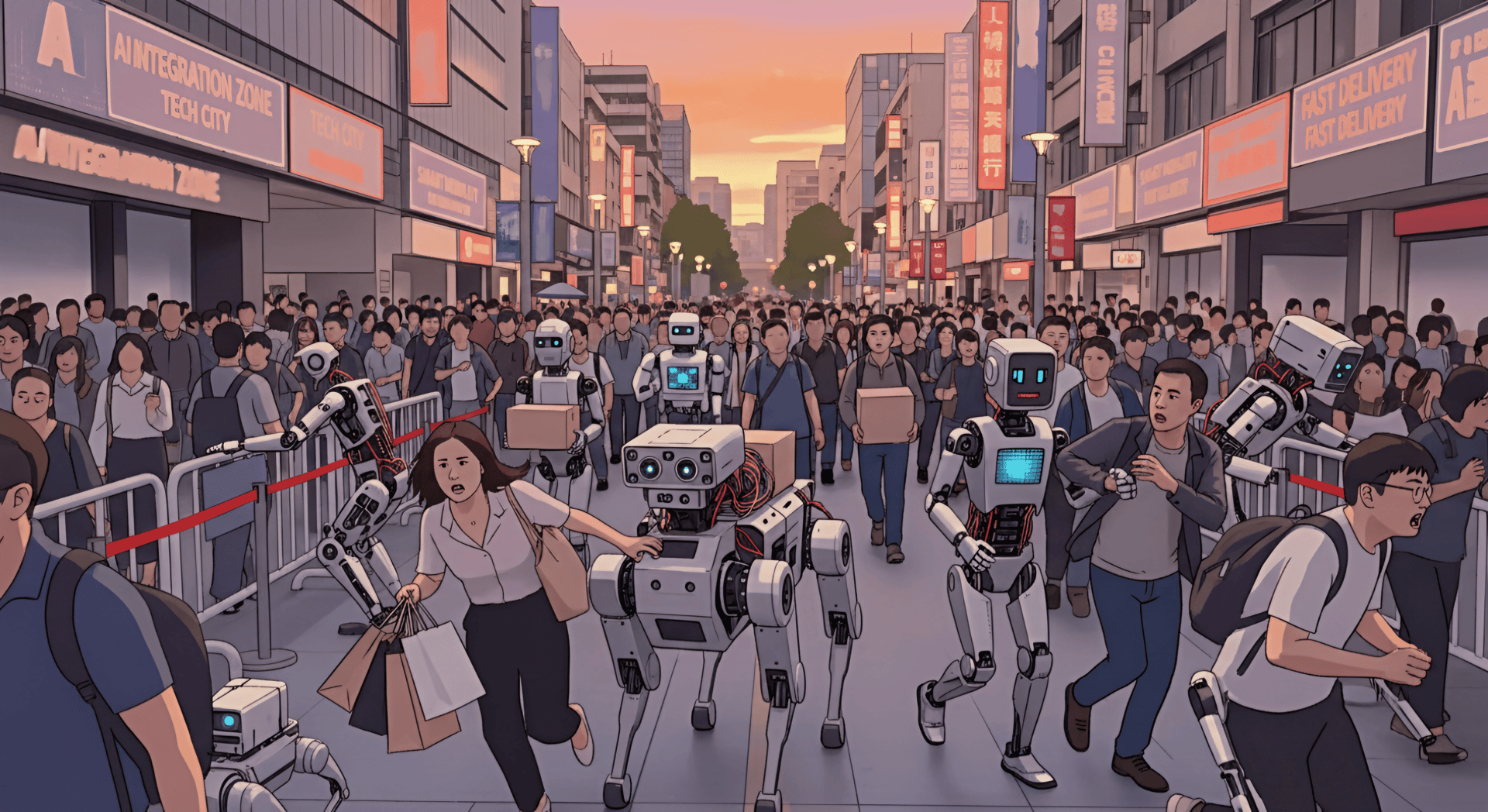
Robots Without Guardrails
What happens when you add AI+Quantum computing + Robotics+Greed = Regret
TECHNOLOGYPREPAREDNESSTHE LAW
C.Colson
6/13/20264 min read

Robots Without Guardrails: Why Exponential Robotics Growth Should Frighten Us
Introduction
I am Gen X. I was raised on possibilities. Many of the possibilities whether presented in film television or print have actually come to exist in our society. AI, Quantum computers, Robots all of these things that seemed like speculations about our future have become real. Now superimpose greed and indifference on to our reality. That is a recipe for regret.
This is what we are facing if we don't act now.
Robotics and AI are advancing faster than most regulatory frameworks. From autonomous drones to AI-driven surveillance and weaponized machines, the same technologies that promise convenience and lifesaving capabilities also lower the barriers to misuse. Without timely oversight, we risk creating systems that amplify human harms at scale — and we may soon regret not having put strong protections in place.
Why exponential growth changes the risk calculus
- Faster iteration and lower cost. Advances in modular robotics, 3D printing, open-source software, and cloud compute mean powerful robots can be built and iterated far more quickly and cheaply than a decade ago.
- Network effects and automation scale. Connected robots and AI systems can act simultaneously and autonomously, multiplying the impact of a single failure or attack.
- Democratization of capabilities. Skills and tools once confined to labs and militaries are now accessible to hobbyists, startups, and malicious actors.
- Unintended emergent behavior. Complex systems interacting at scale produce outcomes that are hard to predict and difficult to reverse.
Military and war — escalation without accountability
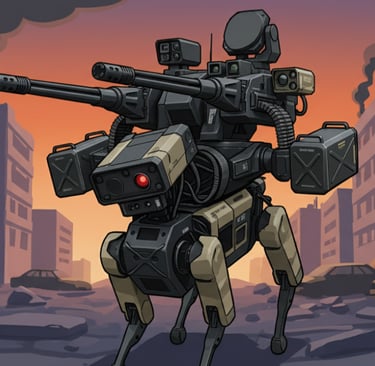
- Autonomous weapons: Lethal weapons systems (LAWS) can select and engage targets without human approval. That removes moral judgment and increases the risk of mistaken, indiscriminate, or rapid escalation.
- Lower threshold for violence: Cheap, autonomous systems reduce the political and financial costs of initiating attacks, increasing the likelihood of proxy conflicts and asymmetric warfare.
- Arms race dynamics: Nations racing to deploy more capable robotic systems may prioritize speed and capability over safety and ethics, creating instability and miscalculation.
- Example risks: swarms that overwhelm defenses, autonomous submarines disrupting sea lanes, civilian casualties from misidentification.
Law enforcement — mission creep and rights erosion
- Surveillance and predictive policing: Robots and embedded AI can extend surveillance reach (drones, street robots, automated cameras). When tied to predictive models, they risk racial bias, false positives, and unchecked monitoring.
- Remote coercion and force: Police robots equipped with less-than-lethal weapons or tasers could be used for crowd control or targeted repression without adequate oversight.
- Accountability gaps: When force is applied by automated systems, it’s unclear who is responsible — the operator, manufacturer, or algorithm designer. That ambiguity undermines legal due process.
- Chilling effects: Deployment of robots for routine patrols or monitoring can reduce public trust and chill lawful protest or community life.
Criminal misuse — new tools for old crimes
- Weaponization by non-state actors: Terrorists, insurgents, and organized crime can adapt drones and ground robots for attacks, surveillance, or contraband delivery.
- Criminal automation: Autonomous delivery of illicit goods, automated reconnaissance for burglary, or robot-assisted smuggling scale traditional crimes.
- Cyber-physical attacks: Robots connected to fragile infrastructure (power, transport) can be hijacked or repurposed to cause physical disruptions.
- Accessibility risk: Tutorials, black-market components, and secondhand hardware lower entry barriers for malicious builders.
Regulatory gaps and why existing frameworks struggle
- Slow policymaking vs. fast innovation: Law and standard-setting typically lag technological progress, creating windows of unmanaged deployment.
- Fragmented jurisdiction: Robotics cross borders and domains (air, land, sea, cyberspace), complicating international coordination and enforcement.
- Technical opacity: Proprietary algorithms, complex supply chains, and invisible failure modes make auditing and certification difficult.
- Lack of harm-centered standards: Many standards focus on functionality rather than misuse-resistance or ethical constraints.
Are we about to regret inaction?
Yes
— unless we act proactively. The combination of high capability growth, low cost, and broad accessibility means the risk profile has shifted from rare, contained incidents to frequent and distributed threats. Delayed regulation allows dangerous norms and infrastructure to ossify (e.g., normalized surveillance ecosystems, accepted use of autonomous force), creating path dependencies that are costly or impossible to unwind.
Practical policy and governance steps (recommendations)
- Ban or strictly limit fully autonomous lethal weapons. Require meaningful human control for use-of-force decisions.
- Create safety and misuse-resistance standards. Mandate tamper-resistance, secure communications, and fail-safe modes for robots operating in public or critical infrastructure.
- Require transparency and auditability. Oblige vendors to provide technical documentation, testing records, and third-party audits for high-risk systems.
- Regulate surveillance use. Limit persistent robotic surveillance; require warrants and strict data-retention controls for law enforcement deployments.
- Licensing and export controls. Treat high-risk robot components and software like dual-use technology with controlled distribution.
- Liability and accountability frameworks. Clarify who is responsible — operators, deployers, manufacturers — when robots harm people or property.
- Public procurement safeguards. Governments should avoid driving demand for risky systems and instead condition purchasing on safety and rights protections.
- International norms and treaties. Negotiate multilateral agreements to prevent arms races and set baseline standards of acceptable behavior.
- Invest in defenses and resilience. Fund detection, countermeasures, and incident response for malicious robotic use.
What responsible development looks like
- "Safety-first" product design: building constrained capabilities, human-in-the-loop controls, and kill-switches by design.
- Ethical audits and red-team testing: stress-testing systems against misuse and publishing results.
- Community oversight: stakeholder boards, public comment periods for deployments, and transparency reporting.
- Education and industry norms: codes of conduct, certification programs, and incentives for safer designs.
A concrete example to illustrate risk
Imagine a commercially available aerial swarm platform that costs a few thousand dollars and can carry small payloads. In the wrong hands, a swarm could be used to coordinate small explosive attacks, overwhelm public-event security, or perform mass surveillance across a city. Because swarms are distributed and autonomous, attribution is harder, defensive responses are more complex, and the social fear generated is disproportionate to individual incidents — all classic amplifiers of harm.
Closing
Robotics offers enormous benefits, but unchecked growth can entrench dangerous capabilities and lower the cost of harm. Thoughtful, timely governance — combined with engineering safety-by-design — can steer these technologies toward social good instead of regret. Now is the time. Our technology is out pacing our humanity. I'll
SOCIAL MEDIA
© 2026. All rights reserved. SEEDBANK369
Instagram-YouTube-Blue Sky
SEEDBANK 369 POLICY INFO