
Race is a construct
Race is a device a construct.
MINDSOULBODYHISTORY
C. Colson
5/27/20263 min read
Race is a construct
Human beings are not separate biological races. We are one species, Homo sapiens, and the biological evidence shows that human variation is continuous rather than divided into fixed racial boxes. Genetic studies have repeatedly found that most human genetic variation exists within populations, not between them, which means two people from the same so-called racial group can be as genetically different from each other as either is from someone labeled another race. This is one of the strongest scientific reasons race is understood today as a social classification rather than a biological one.
A major reason people have historically believed in race is that human beings do differ in visible traits. Skin color, hair form, facial features, and body proportions vary across populations, but these traits are not signs of separate species or clean biological divisions. They are adaptations shaped by geography, climate, and natural selection over long periods of time. For example, darker skin evolved in regions with stronger ultraviolet radiation because higher melanin content helps protect against UV damage, including folate breakdown and skin injury. Lighter skin evolved in lower-UV regions because it can help support vitamin D production. Likewise, traits such as nasal shape and body proportions have been studied as possible climate-related adaptations, with broader patterns often associated with temperature and humidity. These are real biological differences, but they do not map neatly onto racial categories.
Scientific organizations have been clear on this point. The American Association of Biological Anthropologists has stated that racial classifications do not correspond to distinct biological populations. The National Human Genome Research Institute explains that race is a socially defined concept with no genetic basis as a rigid biological system. Genetic ancestry is real; race is not the same thing as ancestry. Ancestry refers to patterns of descent from particular populations and regions, while race is a shifting label created by societies to group people by appearance, power, and history. That distinction matters because a person’s ancestry can be traced through population genetics, but “race” is not a precise scientific measurement.
The fallacy of race becomes even clearer when you look at how racial categories change over time and across countries. In the United States, groups that were once excluded from whiteness, such as Irish, Italian, Jewish, and other immigrant populations, were at different times treated as separate and inferior, then later absorbed into the category of white. That shifting boundary shows that race is not a fixed biological fact. If race were a natural system like blood type or species classification, its boundaries would not change so dramatically depending on political and economic needs. Instead, racial categories have been repeatedly redrawn to justify inequality, labor exploitation, and social control.
Historically, the modern idea of race developed during the era of European colonial expansion, the transatlantic slave trade, and early scientific classification systems. Colonial empires needed ideological justification for enslaving Africans, dispossessing Indigenous peoples, and ranking human groups. Over time, thinkers attempted to classify humanity into hierarchies, often using superficial physical differences as evidence of supposed innate superiority or inferiority. These ideas were not based on rigorous biology; they were deeply entangled with power. The history of race is therefore not the history of discovery, but the history of invention. It emerged as a political and economic tool first, and only later was dressed up in scientific language.
In America, this history became especially powerful. Enslavement, segregation, Jim Crow laws, immigration restrictions, and unequal access to housing, education, and health care all built on racial categories that society treated as natural even though they were constructed. The effects continue today. Race may not be a biological boundary, but racism is a real system with measurable consequences. It affects maternal mortality, environmental exposure, access to medical care, wealth accumulation, policing, and life expectancy. In that sense, the consequences of race are very real even if the category itself is socially made.
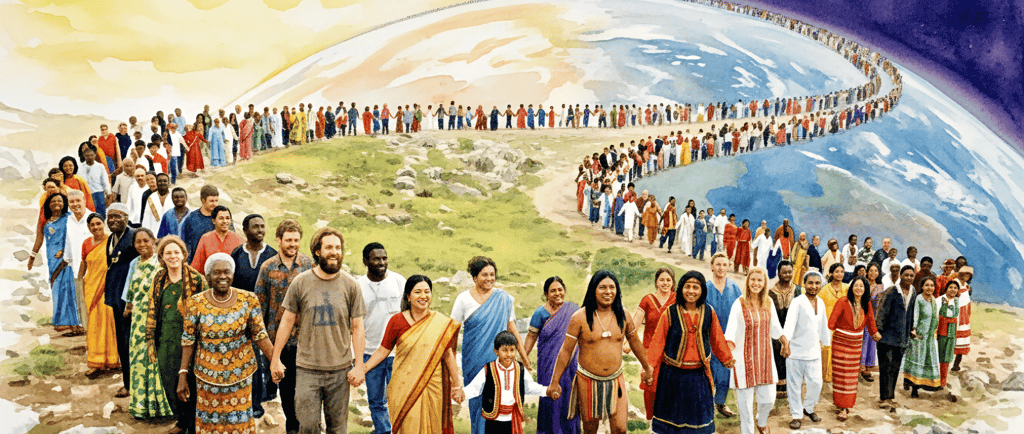
So the culmination is this: humans are one species, shaped by migration, adaptation, and shared ancestry. The visible differences among us are meaningful in a cultural and environmental sense, but they do not divide humanity into separate biological races. The concept of race was created to sort and rank people, especially during colonialism and slavery, and its legacy still shapes the modern world. Understanding that truth does not erase difference; it replaces a false hierarchy with a more accurate view of human unity.
Here are some scientific sources commonly used on this topic:
- National Human Genome Research Institute, “Race” and human genetic variation.
- American Association of Biological Anthropologists statements on race and racism.
- American Society of Human Genetics discussions on human variation.
- Peer-reviewed population genetics research showing greater variation within groups than between them.
- Historical scholarship on colonialism, slavery, and the invention of racial categories.


SOCIAL MEDIA
© 2026. All rights reserved. SEEDBANK369
Instagram-YouTube-Blue Sky
SEEDBANK 369 POLICY INFO